
Trust is one of the hardest problems for online platforms to solve.
A new account may have a verified email address and phone number, but that does not necessarily mean the profile itself is authentic. A user can still upload someone else’s photos, create multiple accounts, impersonate another person, publish inappropriate profile images, or return to a platform after previously being blocked.
At the other end of the spectrum, asking every new user to upload a passport, complete a biometric liveness check, and go through a Know Your Customer (KYC) process may introduce unnecessary friction, cost, and privacy concerns.
This creates an important question for dating apps, marketplaces, social networks, gaming platforms, and other online communities:
Do you need to verify a user’s legal identity — or do you primarily need to establish that their online profile is authentic and trustworthy?
The two problems are related, but they are not the same.
Understanding the difference between profile verification and identity verification can help platforms choose a verification process that matches their actual risks without adding unnecessary friction to the user experience.
What is profile verification?
Profile verification is the process of checking signals associated with an online account to determine whether the profile is authentic and complies with the platform’s rules.
The objective is usually not to establish a person’s official legal identity.
Instead, profile verification may try to answer questions such as:
Does the person in one profile photo appear to be the same person shown in the other photos?
Does a verification image match the person represented by the profile?
Has the same face already appeared across other accounts on the platform?
Are the uploaded profile images appropriate and compliant with the platform’s content policies?
Could the account be impersonating another user or reusing previously uploaded visual material?
For platforms built around interaction between users, these questions can be just as important as knowing someone’s legal name.
Imagga, for example, describes applications of visual AI for identifying fake accounts, verifying marketplace profiles, checking dating-profile photos and preventing impersonation through a combination of image recognition, facial recognition and content moderation technologies.
What is identity verification?
Identity verification goes further. Its purpose is typically to establish that a person is genuinely associated with a real-world identity.
This can involve checking:
- government-issued identity documents,
- a selfie against the photograph on the document,
- biometric liveness,
- personal information against external databases,
- device or fraud signals,
- and, in regulated industries, additional KYC or anti-money-laundering checks.
Identity verification is particularly important where businesses have regulatory obligations or where transactions carry substantial financial or legal risk.
Banks, financial services, cryptocurrency platforms, gambling operators and some mobility or gig-economy services may therefore require stronger identity assurance than a typical social network or online community.
The important distinction is that identity verification is concerned with who a person legally is, while profile verification is concerned with whether an online profile can reasonably be trusted to represent the person behind it.
Profile verification vs identity verification
The two approaches overlap, but they solve different problems.
| Profile verification | Identity verification | |
|---|---|---|
| Primary question | Is this online profile authentic? | Is this person legally who they claim to be? |
| Typical input | Profile images, face images, account data | Government ID, selfie/video, personal information |
| Face comparison | Often | Often |
| Duplicate-account detection | Highly relevant | May be used as a fraud signal |
| Visual content moderation | Highly relevant | Usually not the primary purpose |
| Government ID required | Usually no | Often yes |
| Liveness | Optional depending on solution | Frequently used |
| KYC/AML | No | Often included in regulated use cases |
| Typical industries | Dating, social media, marketplaces, gaming, communities | Finance, crypto, gambling, regulated services |
| Primary objective | Platform trust and account authenticity | Identity assurance and regulatory compliance |
Neither approach is inherently better.
The right approach depends on the level of assurance a platform actually needs.
Why email and phone verification are not enough
Most platforms already verify an email address or phone number during account creation.
This is useful, but it proves only that someone has access to that email account or telephone number.
It does not prove that:
- the profile photographs belong to the user,
- multiple profiles are not controlled by the same person,
- a banned user has not created another account,
- the user is not impersonating someone else,
- or uploaded images comply with the platform’s policies.
These gaps matter because fraud and impersonation increasingly start inside legitimate-looking online accounts.
According to the U.S. Federal Trade Commission, nearly 30% of people who reported losing money to scams in 2025 said those scams began on social media. Reported losses associated with social-media-originated scams reached $2.1 billion. The FTC also notes that scammers can create entirely fake profiles at very low cost and use social platforms to reach people at enormous scale.
The availability of generative AI adds another layer to the problem. The FBI’s 2025 Internet Crime Report notes that AI can be used to create convincing synthetic social profiles and personalized conversations at scale. The report recorded more than 22,000 AI-related complaints associated with over $893 million in adjusted losses during 2025.
Online platforms therefore need more than a verified email address to establish trust.
When full identity verification can be too much
The opposite problem is also common.
A platform may respond to fraud concerns by considering a full identity-verification workflow for every account.
For some businesses this is necessary.
For others, however, requiring a passport or national identity card before someone can create a social, dating, marketplace or gaming profile may be disproportionate to the risk being addressed.
It can introduce several challenges.
User friction
Every additional verification step increases the effort required during onboarding.
Document capture, selfie capture and identity checks can be justified for opening a bank account. Users may be much less willing to complete those steps simply to join a community, list an item for sale or start using a dating application.
Privacy considerations
Government IDs contain highly sensitive personal information.
If a platform does not need legal identity to provide its service, collecting identity documents may introduce data-protection responsibilities that could otherwise be avoided.
Cost
Sophisticated identity-verification processes may involve document analysis, liveness detection, database verification and fraud checks.
That can make sense for high-value or regulated transactions but can become expensive when applied to every user of a high-volume consumer platform.
The problem may simply be different
If the main challenge is that scammers use stolen photographs or repeatedly create fake accounts, checking a passport does not necessarily address the wider visual Trust & Safety problem.
The platform may instead need stronger controls around profile images, duplicate accounts and user-generated content.
This is where profile verification can provide a more targeted approach.
How visual profile verification works
A modern visual profile-verification workflow can combine several computer-vision technologies.
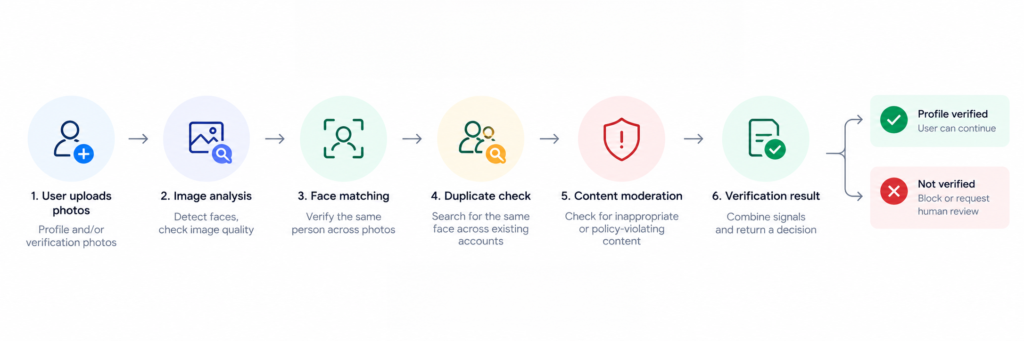
Face matching
One-to-one face comparison checks the similarity between two detected faces.
For example, a platform could compare a verification image with an existing profile image.
The result is generally a similarity or confidence score rather than an absolute declaration that two people are identical.
This type of face comparison is probabilistic. AWS, for example, explicitly recommends treating face-comparison results as confidence-based outputs and applying thresholds appropriate to the use case.
Face search and duplicate-profile detection
A different problem occurs when the platform wants to know whether one face already appears elsewhere.
Instead of comparing one image with another image, a 1 search compares the detected face against a larger indexed collection.
That enables use cases such as:
- “Does this person already have another profile?”
- “Has a previously banned account returned?”
- “Is the same face being used under several identities?”
- “Could an account network be reusing the same people or images?”
Face collections and face-search functionality are supported by computer-vision systems designed for recognition at scale. AWS, for example, allows a supplied face to be searched against all faces stored in a collection.
For platforms dealing with repeat fraud or account duplication, this capability may be more useful than basic 1:1 face matching alone.
Profile image moderation
Authenticity is only part of profile quality.
Platforms also need to determine whether profile images comply with their policies.
AI-powered visual moderation can identify or flag categories such as explicit imagery, violence, harmful content, offensive symbols and other unwanted material.
Automating this analysis helps platforms review high volumes of user-generated images before publishing them or route uncertain cases to human moderators.
Imagga provides AI-powered moderation for images, video and live streaming and positions the technology for social media, dating apps, marketplaces, gaming platforms and Trust & Safety workflows. Its moderation offering can be deployed through cloud and on-premise options.
Liveness detection
Liveness addresses another question:
Is a real person physically present during the verification attempt?
A liveness system can help detect attempts involving printed photographs, images displayed on screens, replayed videos or other spoofing techniques.
For example, Amazon Rekognition Face Liveness uses a short video selfie and returns a probabilistic liveness confidence score. It can then provide a reference image that can be used for subsequent face matching or search.
Liveness can strengthen a verification workflow considerably, but it should not be confused with face matching itself.
A platform can use facial recognition without offering liveness, and liveness alone does not prove someone’s legal identity.
Test Imagga’s Profile Verification demo and explore how face matching and visual profile checks can work in a real verification workflow.
Where Imagga fits
Imagga should be viewed primarily as a visual profile authenticity and Trust & Safety technology provider, rather than a traditional KYC or document-identity-verification provider.
The relevant Imagga capabilities include facial recognition, visual content moderation and technologies for analysing user-generated imagery. Imagga specifically describes applications including fake-account identification, marketplace profile verification and dating-profile checks.
A platform could therefore use visual AI as part of a workflow that checks:
Profile consistency: Do profile photographs represent the same person?
Account duplication: Does the same face appear in other accounts?
Impersonation risk: Is visual content associated with another known profile?
Profile safety: Do uploaded images comply with platform rules?
Visual Trust & Safety: Do the images contain content that should be blocked, flagged or sent for human review?
Imagga does not currently provide a dedicated biometric liveness solution, selfie-capture SDK or dedicated deepfake/synthetic-face detector.
It also should not be positioned as a replacement for complete KYC platforms when government-document verification, AML processes or legal identity assurance are required.
Instead, it can provide the visual verification layer within a wider account-trust architecture.
Which industries benefit most from profile verification?
The distinction between profile verification and identity verification becomes particularly useful in industries where people interact with strangers but where full KYC may not always be necessary.
Dating platforms
Dating applications face a combination of impersonation, catfishing, stolen photographs, explicit imagery, duplicate accounts and romance scams.
Profile verification can therefore combine face consistency, duplicate-profile detection and image moderation.
The problem has meaningful real-world consequences. FTC data show that nearly 60% of people who reported losing money to a romance scam in 2025 said that the interaction began on social media.
Online marketplaces
Marketplaces need to establish trust between buyers and sellers while also moderating large volumes of visual content.
Potential checks can include seller-profile verification, repeated account detection and moderation of uploaded profile and listing images.
The same visual AI infrastructure can therefore contribute to both user trust and listing quality.
Social and community platforms
For social networks, forums and communities, requiring legal identification from every member may be unrealistic.
Profile verification provides an intermediate trust layer by helping identify duplicated or suspicious accounts while simultaneously screening user-generated imagery.
Gaming platforms
Gaming communities may face fake accounts, repeated abuse, inappropriate avatars and visual content, scams and account farming.
Here again, the goal is often not proving a user’s government identity but preventing abuse and creating a safer community.
Profile verification and identity verification can work together
This does not have to be an either-or decision.
Platforms can combine different verification levels according to risk.
For example, a marketplace might allow most users to join with basic account and profile verification.
Additional identity checks could then be triggered when:
- transaction values become high,
- fraud signals are detected,
- a user requests access to sensitive capabilities,
- regulatory requirements apply,
- or an account’s behaviour crosses a defined risk threshold.
This creates a layered model:
Basic account verification → profile authenticity checks → enhanced verification → full identity/KYC verification when necessary.
Such a risk-based approach can help platforms add stronger controls where they matter without forcing every legitimate user through the most demanding verification process.
Choosing the right verification approach
The starting point should not be:
“Which identity verification provider should we buy?”
It should be:
“What exactly are we trying to verify?”
If the requirement is:
We need to know this person’s official legal identity, a KYC or identity-verification provider is likely appropriate.
If the requirement is:
We need to know whether this profile’s photographs are consistent and trustworthy, face matching may be enough.
If the requirement is:
We need to know whether the same person is creating multiple accounts, a searchable facial-recognition index becomes especially important.
If the requirement is:
We need to prevent inappropriate profile images and unsafe user-generated visuals, content moderation belongs in the workflow.
And when the platform needs several of these capabilities together, profile verification becomes part of a wider Trust & Safety architecture rather than a single verification check.
Building trust without unnecessary friction
Online platforms increasingly face two competing pressures.
Users expect them to prevent fake profiles, fraud, impersonation and abusive content.
At the same time, legitimate users expect fast onboarding, privacy and a frictionless experience.
The answer is not necessarily to identify every user as aggressively as possible.
It is to apply the right level of verification for the risk being addressed.
Identity verification is critical when legal identity or regulatory compliance matters.
Profile verification addresses a different but equally important question: whether the account and the visual identity presented to other users can reasonably be trusted.
For dating platforms, marketplaces, gaming communities and social applications, technologies such as face matching, duplicate-account detection and visual content moderation can provide a valuable middle layer between basic email verification and full KYC.
And as fake profiles and AI-assisted scams become easier to create, that middle layer is becoming increasingly important.
Want to explore how visual AI can support profile verification on your platform? Explore Imagga’s Facial Recognition and Content Moderation technologies or contact our team to discuss your use case.